

What Size Drones Must Be Registered
Although originally built for military purposes, drones have seen rapid growth and advancements and made a break to consumer electronics.
Their original use was as weapons, in the grade of remotely-guided aerial missile deployers. However, today, drones have found a wide range of applications for civilian use, particularly in the form of pocket-size quadcopters and octocopters.
Today, drones are used for a wide range of functions, including monitoring climate change, delivering appurtenances, aiding in search and resuce operations, and in filming and photography.
Of course, UAVs are also an increasingly important part of the armed forces in many countries. American armed forces alone have a fleet of tens of thousands of drones today, compared to just a few xx years ago. This is dwarved, however, by the number of drones in private utilize. According to the FAA, there were 1.one one thousand thousand drones registered in the U.S. in 2019.
RELATED: DRONES FOR SEARCH-AND-RESCUE, Delivery SERVICES Have-OFF
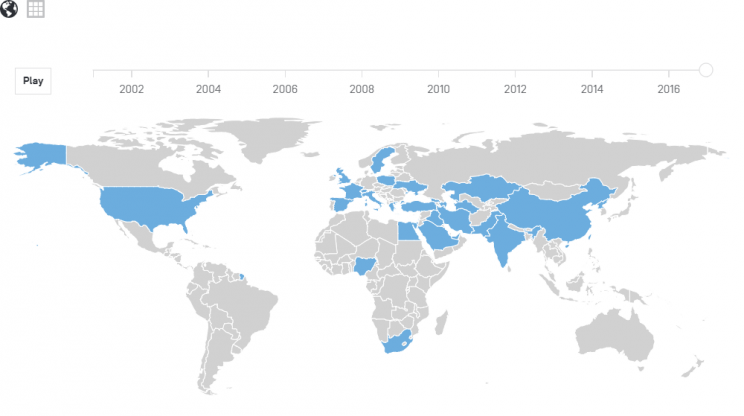
What is considered to exist a drone?
Before we get into the nitty-gritty of the history of drones, it might be useful to actually define what we are talking about.
According to various dictionaries, a drone tends to exist defined as:-
"An unmanned shipping or send guided past remote control or onboard computers." - Merriam Webster.
While the term also has other meanings, for the context of this commodity, a drone is, in effect, an unmanned flying object either controlled remotely or operating completely autonomously.
"A drone , in technological terms, is an unmanned aircraft. ... Essentially, a drone is a flying robot that can be remotely controlled or fly autonomously through software-controlled flight plans in their embedded systems, working in conjunction with onboard sensors and GPS." - Internet of Things Agenda.
Hither nosotros will focus on this particular aspect of drone technology.
Some of the earliest armed forces drones appeared in the mid-1850s

The concept of drones may well engagement back to 1849, when Republic of austria attacked Venice using unmanned balloons stuffed with explosives. Austrian forces, who were besieging Venice at the time, launched around200 of these incendiary balloons over the city.
Each airship carried anywhere between 24 (11 kg) toxxx (14 kg) pounds of bombs. Once in position, these bombs were dropped from their carrier balloons to wreak havoc on the urban center beneath. Fortunately for the Venetians, only one bomb found its mark, equally well-nigh of the balloons were blown off-form due to a sudden change in wind direction.
As innovative as this event was in the field of armed forces engineering, the utilize of balloons does non really encounter the current definition of drones, peculiarly military drones, as we take seen higher up.
That being said, it is very interesting to encounter the basic concept of drones was being considered past military machine technologists more than170 years agone. It is this kind of thinking that would drive drone technological development over the coming centuries and decades.
One of the first quadcopters appeared in the early on-1900s

One mutual feature of many modern commercial drones is the quadcopter configuration. Early evolution of this technology appeared in 1907, when brothersJacques and Louis Bréguet, with help of French physiologist Professor Charles Richet, developed an early instance with their gyroplane, a forerunner of the helicopter.
For its time, the blueprint of the copter was visionary. Althoughit accomplished the first rise of a vertical-flight aircraft with a airplane pilot, it only reached a height of 0.6 meters. It was likewise not a free flight, every bit iv men were needed to steady the construction.
That beingness said, information technology did demostrate that the concept of a quadcopter would work for flight -- information technology would only have more technological development to go far viable.
Again, like the incendiary balloon used past the Austrian regular army more than 50 years before, this was still not, technically speaking, a drone as we know it today.
Swiftly moving on.
1915-1920 saw a big leap forward in the applied science

Moving forwards a little bit in time, the outset pilotless shipping was adult in 1916, after the outbreak of Earth State of war I. Called the Ruston Proctor Aerial Target, these pilotless armed forces drones used a radio guidance system developed past British engineer Archibald Low.
Using a paw-picked team of around thirty men, Low rapidly built a pilotless airplane which was launched from the back of a truck using compressed air (besides a first). In 1917, Low and his team too invented the outset wireless or rocket. The technology for this would later on exist adapted by the Germans for their V1 rocket plan in WWII.
Although Depression's projects had some success, and Low was nicknamed "the father of radio guidance systems," his work was not followed up by the British war machine after the war. The cutting border nature of Depression's piece of work was not appreciated past the British government, although the Germans certainly understood its importance - they made ii attempts to assassinate Low.
Shortly after this, the U.S. Army built the Kettering Bug, which used gyroscopic controls and was intended to be used as an "aerial torpedo". Each "Bug" was launched from a 4-wheeled dolly that rolled down a portable track.
"After a predetermined length of time, a control closed an electric circuit, which shut off the engine. Then, the wings were released, causing the Issues to plunge to globe -- where its 180 pounds (82 kg) of explosive detonated on bear on." - National Museum of the United States Air Strength.
Around 50 of the "Bugs" were built by theDayton-Wright Aeroplane Co., but they arrived too late to actually see any combat.
1930-1945 saw other major leaps forward in armed forces drone engineering

Subsequently WW1, UAV technological developments continued unabated. In the 1930s, the U.S. Navy began experimenting with radio-controlled aircraft, which resulted in the development of Curtiss N2C-2 Drone in 1937.
In 1935, the British developed "Queen Bee", a radio-controlled target drone, which is likewise believed to take led to the use of term "drone," for radio-controlled unmanned aircrafts.
Radioplane OQ-2, a remote-controlled model aeroplane adult past British actor Reginald Denny and engineer Walter Righter in the 1930s, actually became the first mass-produced UAV product in the U.South. Nearly 15,000 drones were manufactured for the military machine during the state of war.
However, the actual credit for inventing a radio-controlled aircraft that could fly out of sight goes to Edward M. Sorensen, who patented an invention that used a basis final to runway the movements of the airplane. Before this evolution, early RC aircraft could but operate within the visual sight of the controlling pilot.
Still, the most notable effect of the Second Globe War, with regards to drones, was the emergence of the V-one "Doodlebugs" of the High german army. Fitted with pulsejets, these crafts were effectively the world's starting time-e'er prowl-missiles.

They were used in a campaign of "terror bombing" in British cities similar London, in an effort to demoralize the British public. Their guidance systemused a uncomplicated autopilot to control distance and airspeed; a pair of gyroscopes controlled yaw and pitch; the azimuth was maintained using a magnetic compass; a barometric device was used to control altitude. T he gyros, rudder, and lift were controlled using pressurized air.
The technology was later opposite-engineered by the Americans, who developed their own pulsejet-powered unmanned aerial drones like the TD2D-1 Katydid and Curtiss KD2C.
The Vietnam State of war saw the first utilize of drones with cameras for reconnaissance

Leaping forward a few years, the next big footstep in drone technology occurred during the Vietnam State of war. This state of war saw the first widespread deployment and use of drones as dedicated reconnaissance UAVs.
Not just that, but "drones also began to be used in a range of new roles, such every bit interim every bit decoys in gainsay, launching missiles against fixed targets, and dropping leaflets for psychological operations," according to the Purple State of war Museum, London.
In the late 1950s, the U.S. spy aeroplane, the manned SR-71 Blackbird, was all the same in development and spy satellites were also not set up for deployment, but yet.
What was needed were specialized UAVs to safely get together information in gainsay areas. Some models did be, like the Ryan 147Bs, but these needed to exist piggybacked on C-130s and parachuted to the basis in friendly territory to recover whatever information they gathered.
The need for drones as well occurredto many other nations effectually the world, who also began to explore the use of UAVs for various military applications. New drone models became more than sophisticated as designers focused on improving endurance and the height at which the drones could safely operate.
Recreational RC planes became big during the 1960s

Thank you to breakthroughs in transistor technology at this time, radio-controlled components could now be miniaturized enough to be sold to noncombatant customers at a reasonable toll. This led to something of a blast in RC planes during this decade.
Planes began to appear in kit form that allowed enthusiasts to build and fly RC craft either indoors or outdoors. A large number of RC aircraft clubs were too started up by hobbyists. This created a cottage manufacture, which would speed up the development of commercial RC technology.
Assault armed forces drones were seriously beefed up during 1980-1989
Even though the U.S. was able to achieve a breakthrough in the mass-manufacturing and supply of drones for the military, UAVs were often considered unreliable and expensive. This perspective changed in 1982 when Israeli forces used unmanned aircraft to gain a victory over the Syrian Air Force with minimal losses.
The U.Southward. also began the Pioneer UAV Program in 1980, with the goal of building an cheap drone for fleet operations. A joint project by the U.Due south. and Israel in 1986 led to the development of the RQ2 Pioneer – a medium-sized reconnaissance shipping.
Also during this catamenia, drone developers began to focus their attention on alternative power sources for drones. I obvious source was solar power.
This led to some interesting solar-powered drones being developed, including the AeroVironment HALSOL.
1990-2010 was a pivotal menstruum for war machine and noncombatant drone evolution
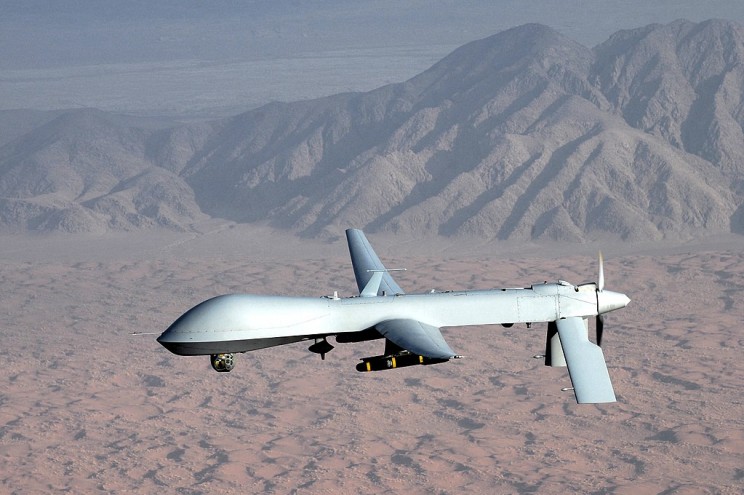
Mini and micro versions of UAVs were introduced in 1990, and, the famous Predator dronewas introduced in 2000. This was used in Afghanistan to launch missiles and in the search of Osama Bin Laden. In the following years, a number of small-scale-sized, fixed-wing surveillance drones such as Raven, Wasp, and Puma were developed by AeroVironment Inc.
Raven is currently used in a number of countries, with tens of thousands of units deployed.
2006 was another pivotal year in the history of drones. This was the year that the FAA officially issued the beginning commercial drone permit.
However, consumer applications were irksome to first, with very small numbers of people applying for permits in the beginning few years.
2010-today might just be the "Golden Age" of drones

The last x years or then have seen a huge explosion in drone innovation and commercial involvement. While prior to this, drones were primarily used for armed services purposes or hobbyists, beginning in the early-2010s, a host of new uses were proposed for drones, including their use as delivery vehicles.
By the eye of the decade, the FAA was seeing a massive growth in need for drone permits, with around 1000 commercial drone permits issued in 2015.
This number tripled one twelvemonth later and has continued to abound exponentially since.
Equipping drones with cameras is at present commonplace in commercial photography and videography. This is the upshot of a merging of radio-controlled (RC) aircraft and smartphone technology.
The rapid growth in the usage of smartphones reduced the prices of microcontrollers, accelerometers, and camera sensors, which are ideal for use in fixed-wing hobbyist aircraft. Further advances allowed a drone with 4 or more rotors to be controlled by adjusting the speed of private rotors.
Improving the stability of multirotor aircraft opened up new possibilities for them to be used in a number of ways.

The use of DIY drones is also becoming more popular. Because of their smaller size and portability, DIY drones take the potential to exist used by constabulary forces and burn services for surveillance.
However, the growing use of unregulated UAVs has also raised questions about privacy and physical safety.
What is the future of drones?
The future of drones looks highly promising. Gartner predicts that the global drone market will grow substantially over the next few years.

Business Insider, for case, expects global shipments of drones to rise to 2.4 million by 2023 -- that is a 66.8% compound annual growth rate.
"Drone growth will occur across the four main segments of the enterprise industry: Agriculture, structure and mining, insurance, and media and telecommunication," told Business organization Insider.
For military applications, drones are expected to become smaller and lighter with much longer battery life and flying times. There volition likewise be developments in improving drone optics and other capabilities further. In the civilian market place, developments in improving flight times are allowing them to serve as delivery platforms, for utilise in emergency services, and for data collection in a number of areas likewise dangerous for humans, such as in power plants or fires.
Drones have also been deployed for home security and crowd control in some countries. While a worrying development, authorities in some areas are probable to keep the use of drones for this blazon of surveillance.
Miniaturization is also likely to play a massive part in the hereafter of drones. As components are fabricated smaller and smaller, drones volition also be dramatically reduced in size.
It is not inconceivable that micro-drones will become commonplace in military and commercial/industrial applications in the not also distant hereafter. Much like the contempo pocket-size drones recently commissioned by the U.Due south. Army.

Who knows, perhaps microscopic drones might not be too far abroad.
Development in flight control algorithms, machine vision, and onboard processing power will farther enable drones to make decisions themselves, rather than relying on human input, further improving the drones' reaction fourth dimension and speed.
Despite the dandy potential for drones to exist used as a weapon, a number of groups have also raised questions near the ethics of this blazon of remote weaponry, given the possibility of errors resulting in the deaths of civilians considering of inaccurate data.
While some claim that UAVs are a threat to privacy and safety, others believe that this is outweighed by their potential to be used for the meliorate. Whatever the opinions are, drones are expected to increase in number as they become smarter and more capable, and discover uses in a wider number of industries and a wider number of roles in the future.

Source: https://interestingengineering.com/a-brief-history-of-drones-the-remote-controlled-unmanned-aerial-vehicles-uavs
Posted by: smithbrose1970.blogspot.com
0 Response to "What Size Drones Must Be Registered"
Post a Comment